


Is an MBA Still Worth it in the Age of AI?

The global conversation about work, education, and human progress has been taken over by AI, so much so that Times crowned “the architects of AI” as its Person of the Year last year. As industries shift and roles are redefined, companies are reevaluating how they hire and train employees.
And as a result, one question we’re seeing more often is: Is an MBA still valuable?
Our short answer: Even more so!
Why You Must Be AI-Native Now
As AI continues to be at the forefront of workplace innovations, being AI native is now a highly desirable skill. Professionals who are fluent in how AI thinks, what it can do, and where it fails, and who can make better decisions because of it are now in high demand.
The World Economic Forum's Future of Jobs Report 2025 lists AI and big data literacy among the fastest-growing skills in the global workforce. PwC's Global AI Jobs Barometer found that workers with AI skills command wage premiums up to 56% higher than their peers. And LinkedIn's 2025 data flagged AI literacy and large language model proficiency as the fastest-growing skills globally. The EU AI Act now legally requires employers who are providers or deployers of AI systems to ensure staff have sufficient AI literacy.
This is because companies are funneling millions into AI. Goldman Sachs has launched a new LLM for its bankers to use as a "copilot assistant" and extract analysis. Morgan Stanley recently introduced its "AI@Morgan Stanley Assistant”. JP Morgan Chase is using AI for wealth management, consumer banking, customer service, and fraud prevention.
These employers (who are traditionally big recruiters at MBA programs) aren’t satisfied with knowing how to use AI tools and prompt engineering anymore. They want to see that you can understand what it’s doing, know when to override it, apply it to different use-cases, and take responsibility for the outcomes either way.
See this page from a 1979 IBM internal training doc:
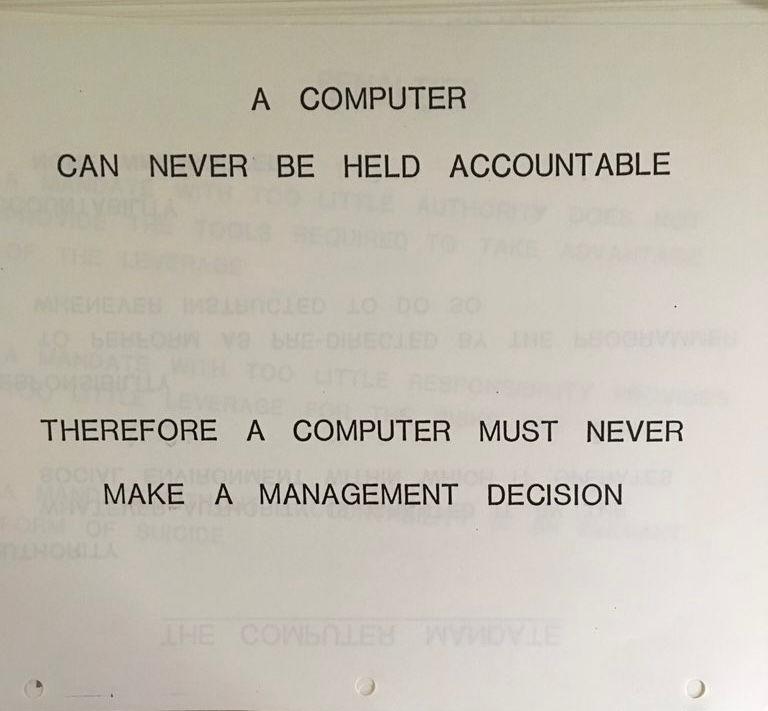
The professionals who will thrive over the next decade will be those who know which questions to ask and how to amplify their own skills using AI.
Why an MBA Is Good Training for AI
AI-Native Leaders: Most people assume an MBA is about learning business: finance, marketing, operations, strategy. But the real value of an MBA has always been in the leadership and strategic thinking it provides, which an algorithm can’t code its way into.
AI is great at pattern recognition, summarizing large amounts of information, and collating data. But leaders make decisions about the future that can be ambiguous and high-stakes, often with incomplete data and very human considerations. And MBA programs can offer the framework to integrate the two, building leaders who can direct an AI system, interrogate its outputs, and then make a call.
ROI: The MBA continues to be a great investment, too. According to the Graduate Management Admission Council, the median salary for MBA graduates in the US sits around $125,000, compared to roughly $75,000 for those with bachelor's degrees. A majority of corporate recruiters continue to rate full graduate business degrees as more effective for long-term success than short-form credentials. That preference has been steady since it was first measured by GMAC in 2022, even as the AI conversation has intensified.
Network: Business is relational. The most valuable opportunities in most careers will not come from the “Easy Apply” button on LinkedIn, but from conversations with someone from your network. The MBA gives you a cohort of high-performing peers, faculty, and an alumni community that spans sectors and geographies. And in an increasingly digital, AI-mediated world, more and more people seek out trusted human relationships.


Sam 
Jon 
Zack 
Malvika 
Rowan 
Nanako 
Mario
How Companies Are Recruiting for AI at Business Schools
The MBA recruiting landscape is shifting to respond to modern business needs.
For example, at MBB:
McKinsey has added an AI interview to its final-round process for US candidates.
BCG reported that AI- and tech-focused services now represent over 40% of BCG's total revenue of $14.4 billion in 2025, and its hiring pipeline is following the revenue.
Bain's research found that AI-related job postings have surged by 21% annually since 2019.
All three MBB firms are now aggressively building AI talent pipelines, with BCG actively limiting hires of purely "generalist MBAs" while recruiting engineering and AI-related talent. It’s clear that the firms that hire most MBAs are themselves becoming AI businesses, and they want graduates who can operate in that world from Day 1.
But the skills that are in demand, like AI strategy, change management for AI adoption, and AI governance and risk don’t need a tech background. They need leaders who can build trust in others, manage ambiguity and crises, and translate between the algorithm and the boardroom. That's an MBA skill set.
The GMAC's Corporate Recruiters Survey reinforces it: 63% of corporate recruiters worldwide expect business graduates to use AI for knowledge acquisition and new skill development, and 62% want them applying AI directly to strategy and decision-making.
In today’s soft job market, it’s becoming increasingly important to distinguish yourself by being AI-native and demonstrating this in the MBA recruiting cycle.
How MBA Programs Are Incorporating AI in their Curriculum
The MBA curriculum is adapting to meet this shift. Three structural shifts stand out at the programs leading the charge.
AI literacy is moving from elective to core. Harvard made it mandatory in 2025. Wharton launched a full MBA major in AI for Business the same year. The signal is clear: AI fluency is now a baseline requirement for every graduate, regardless of which industry they're heading into.
Human skills are the competitive edge. As technical tasks get automated, the differentiators become entirely human: communication, ethical reasoning, cross-functional collaboration, change leadership.
Applied, real-world learning is replacing pure theory. Top programs are immersing students in actual business problems: AI integration challenges, digital transformation projects, organisational change under uncertainty. Knowing frameworks isn't enough anymore. You have to execute, adapt, and own the outcomes.
Here’s what our client Mario, who was admitted to Wharton and won $851,000 in total scholarships, had to say about the AI shift at Wharton:
Being an MBA coming into the workforce now, that's what I feel a lot of recruiters are looking for — that know-how and capacity to come in as an employee and readjust their work processes into enabling or enhancing AI applicability.
A recent analysis of 20 elite MBA programs by Poets & Quants found Stanford GSB far ahead of peers in AI course volume, with 30 courses spanning machine learning, ethics, policy, and domain-specific applications across healthcare, finance, and operations. MIT Sloan tops the 2026 FT Global MBA Rankings because of its long-standing reputation at the intersection of technology and strategy. Kellogg launched a new cross-functional AI curriculum in 2025, taught across five departments simultaneously to reflect how AI actually appears in organisations.
Top-10 AI Classes in MBA Programs
Here are ten standout AI courses from the M7, T20, and top European schools:
1. DSAIL: Data Science and AI for Leaders — Harvard Business School
Introduced in 2025 as a mandatory first-year course for all HBS MBA students, DSAIL is meant to provide foundational fluency in machine learning, data science, and AI strategy.
2. AI for Business Major — Wharton School, University of Pennsylvania
Launched in 2025, Wharton's full MBA major in AI for Business is one of the most comprehensive offerings at any elite program. Core requirements include Applied Machine Learning in Business and Big Data, Big Responsibilities: Toward Accountable AI, taught by Professor Kevin Werbach, director of Wharton's Accountable AI Lab. Wharton also provides ChatGPT licences to all MBA students.
3. Generative AI for Managers — MIT Sloan
Students will develop both technical fluency and strategic perspective in generative AI. The curriculum moves from foundational concepts (how large language models function, how to engineer effective prompts, and when to fine-tune) toward higher-order questions of business application, economic impact, and competitive positioning, including how venture capital is shaping the field.
4. AI Foundations for Managers — Kellogg School of Management, Northwestern
Kellogg's 2025 AI curriculum is taught across 5 departments simultaneously to mirror how AI actually lands in organisations. For those who want to go deeper, Kellogg's MBAi programme sits at the full intersection of business and computer science, one of the most forward-looking offerings in the world for professionals targeting the AI space specifically.
5. Business Analytics Concentration — Chicago Booth School of Business
Booth was one of the first elite programs to formalise a Business Analytics concentration. Today that offering includes AI and machine learning modules alongside some of the strongest quantitative finance and econometrics training out there.
6. AI, Data and Decision Science Track — Darden School of Business, UVA
Darden has embedded AI directly into its core strategy curriculum. The dedicated track then allows students to go further, with 25 courses spanning analytics, machine learning, and AI ethics.
7. AI Strategy — London Business School
LBS is one of the most active European programs on AI, with nine dedicated AI courses in its curriculum. The AI Strategy offering focuses on how leaders should think about competitive positioning and value creation as AI reshapes entire industries. This is particularly valuable for LBS's internationally diverse cohort, many of whom will be deploying AI strategy in markets where the context looks very different from Silicon Valley.
8. AI Strategy and Leadership Programme — Oxford Saïd Business School
Oxford Saïd’s flagship AI Strategy and Leadership Programme helps executives establish and implement a strategic vision for AI across their organisation, while the Executive Diploma in Artificial Intelligence for Business provides a deeper, accredited pathway that also counts toward Oxford's Executive MBA. Oxford's programmes explicitly cover AI ethics, regulation, and compliance (increasingly important as the EU AI Act reshapes what companies are legally required to do).
9. Artificial Intelligence and Other Disruptive Technologies / Implementing Generative AI Ethically — Cambridge Judge Business School Cambridge Judge’s MBA electives cover both how the technology works and its managerial implications, including how to manage staff through disruption and how AI gets adopted inside organisations. The school has also launched a dedicated AI Leadership Programme with Cambridge's Leverhulme Centre for the Future of Intelligence for senior leaders.
10. Data Science (and Machine Learning) for Business - INSEAD
A core MBA elective taught by the school's analytics faculty, covering how machine learning techniques get applied to real business decisions.
Speak with one of our expert admissions consultants to learn how you can clearly define your AI goals in your MBA applications.


.png)
.png)
.png)


_JPG.jpg)


